


I’ll be honest with you: I avoided Meta ads for a long time because every time I tried to figure out the platform it felt like I needed a degree I didn’t have. The dashboard was confusing, the terminology was its own language, and the tutorials somehow made it worse. So I kept pushing it off and telling myself I’d figure it out eventually.
What changed is that Meta released an official AI connector that links directly to your ad account so instead of navigating a dashboard full of dropdowns and acronyms you just have a conversation. You ask Claude a question about your campaigns in plain English and it answers you using real data from your actual account. You describe what you want to promote and your budget and it builds the campaign structure for you. You ask it which ads are wasting money and it tells you, specifically, and it tells you what to do about it.
I’ve been using it for a few weeks now and I want to walk you through exactly how it works because I think this is one of those things that sounds like hype until you actually try it and then you can’t believe you were doing it any other way.
Before any of this makes sense you need to know how Meta ads are actually structured because the platform is built around three levels and once you get it everything clicks into place.
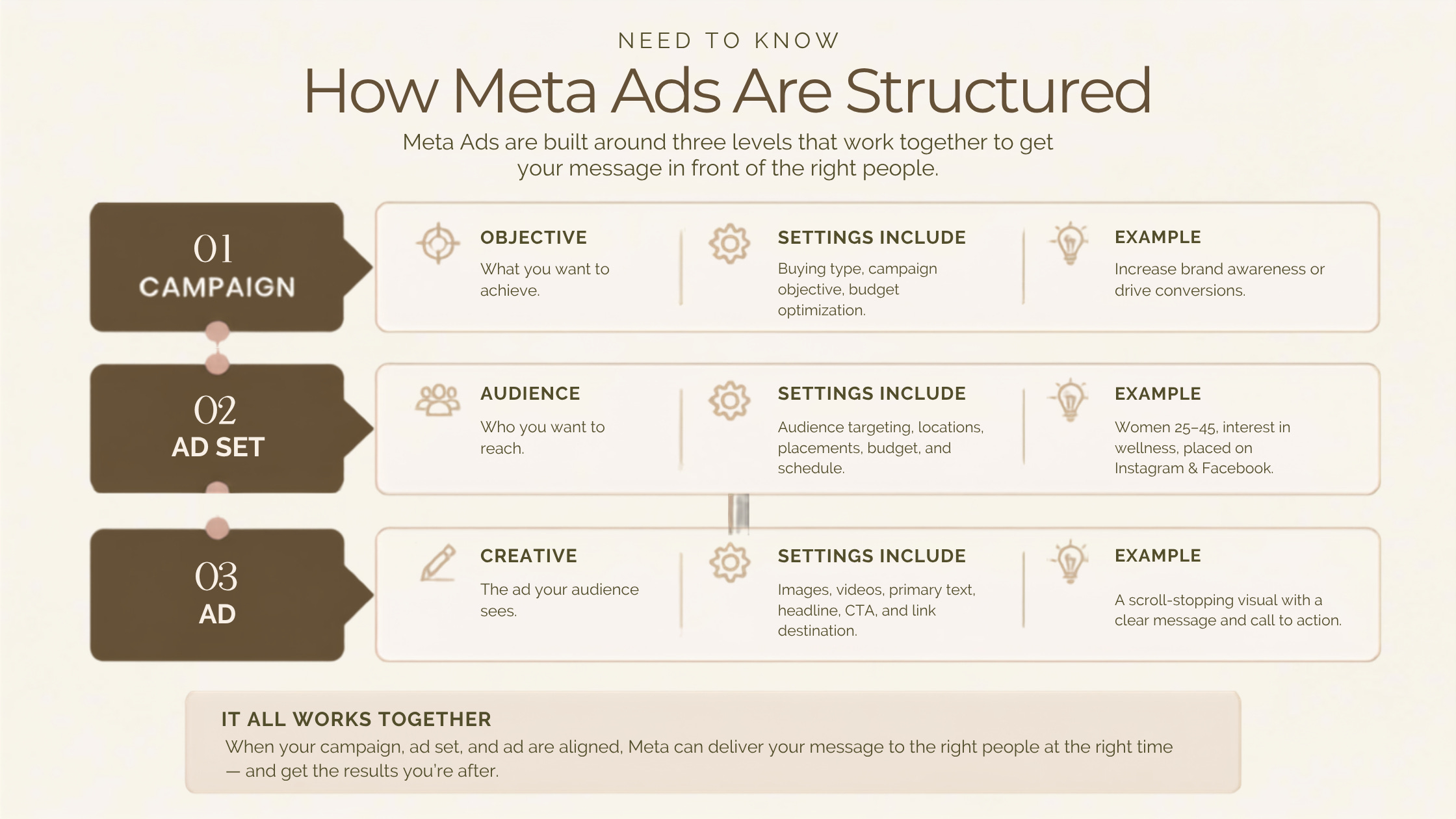
Your campaign is where you set your goal and that’s the only job of the campaign level. What do you want? More people to book a call, visit your website, watch your video, fill out a form? You pick one goal and that’s your campaign.
Your ad set is where you set your audience and your budget. Who sees this ad? People in your city, people interested in wellness, people who already follow you on Instagram? How much are you spending per day? That all lives at the ad set level.
Your ad is the actual thing people see, the image or the video, the words, the button that says “book now” or “learn more.”
Campaign is your goal, ad set is your audience and budget, ad is your creative. Three levels. That’s the whole structure and everything in the platform flows from that.
